
The Rules in Brief
Poople is a daily word ladder game. Each day you receive a four-letter starting word and your goal is to reach POOP in as few steps as possible. Every step must be a real four-letter word that differs from the previous word by exactly one letter. You can change any of the four letter positions, one at a time. For full details on what counts as a valid guess, visit the FAQ.
The puzzle is shared worldwide, so every player faces the same starting word each day. Like Wordle, everyone in the world gets the same daily puzzle. The twist is that you build a ladder to POOP one letter at a time rather than guessing a hidden word. Your result is compared against par, which is the true minimum number of steps required to reach POOP from that starting word.
How Scoring Works
Par is computed by running a breadth-first search over the complete word graph. The search finds the shortest possible path from the starting word to POOP, using the game’s dictionary of 2,398 four-letter words. If you reach POOP in exactly par steps, you have achieved the best possible result.
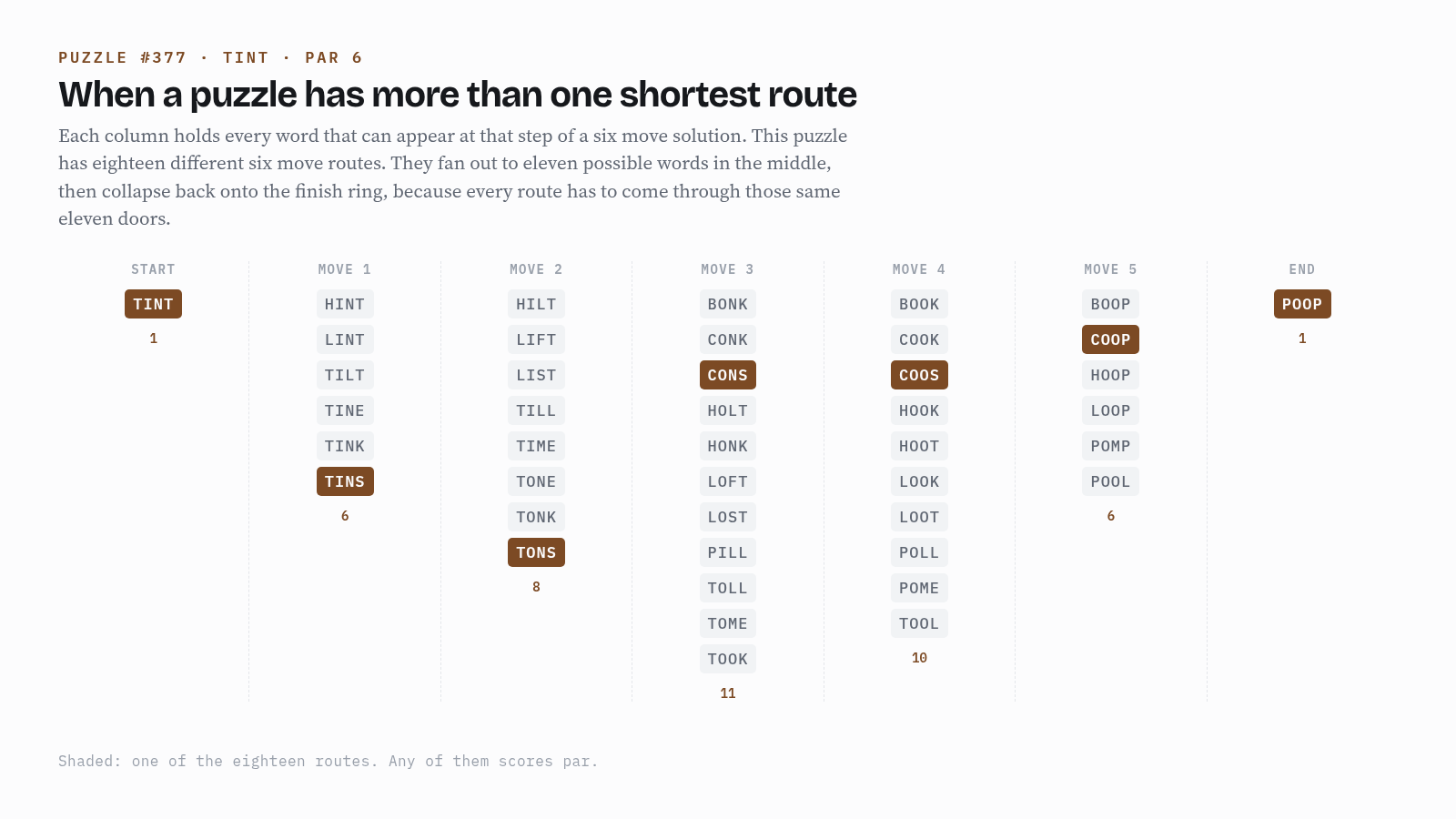
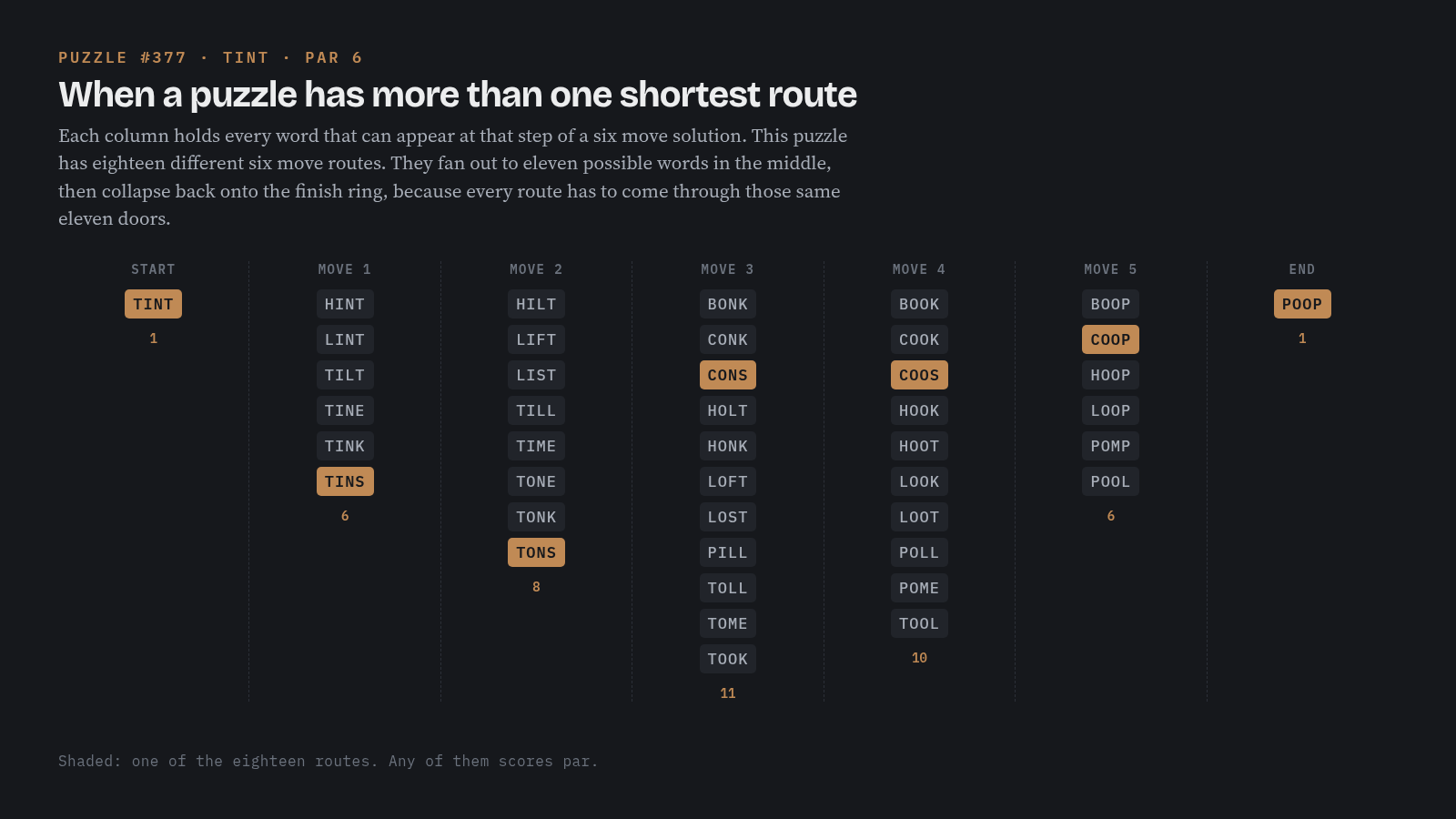
Several puzzles have more than one shortest path. The par is always the true minimum length. Any route that reaches POOP in par is equally valid, so there is no single “correct” solution when multiple shortest paths exist. Finding any one of them scores you par.
Steps beyond par are counted against your result. If par is 5 and you finish in 7, you are 2 over par. Tracking this number across days tells you whether your strategy is improving.
Core Strategies
Here is how to solve a word ladder more efficiently, whether you are stuck on today’s puzzle or chasing a better score against par.
Change a vowel first. Four-letter words tend to cluster around shared consonant frames, and swapping the vowel opens the most doors quickly. Starting from WELL, a single vowel change reaches WALL or WILL, each of which sits in an entirely different region of the word graph. Vowels are the cheapest pivots.
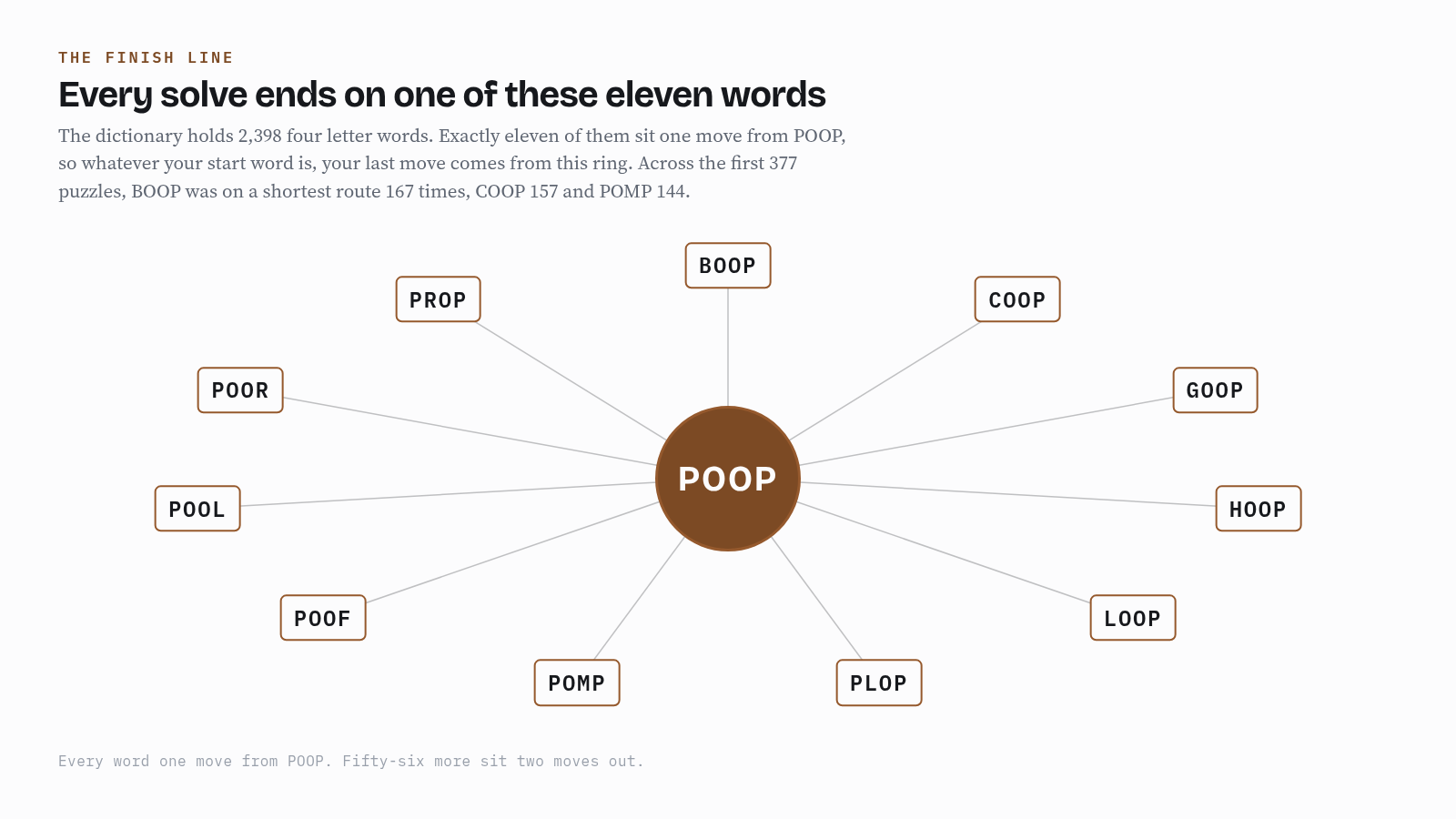
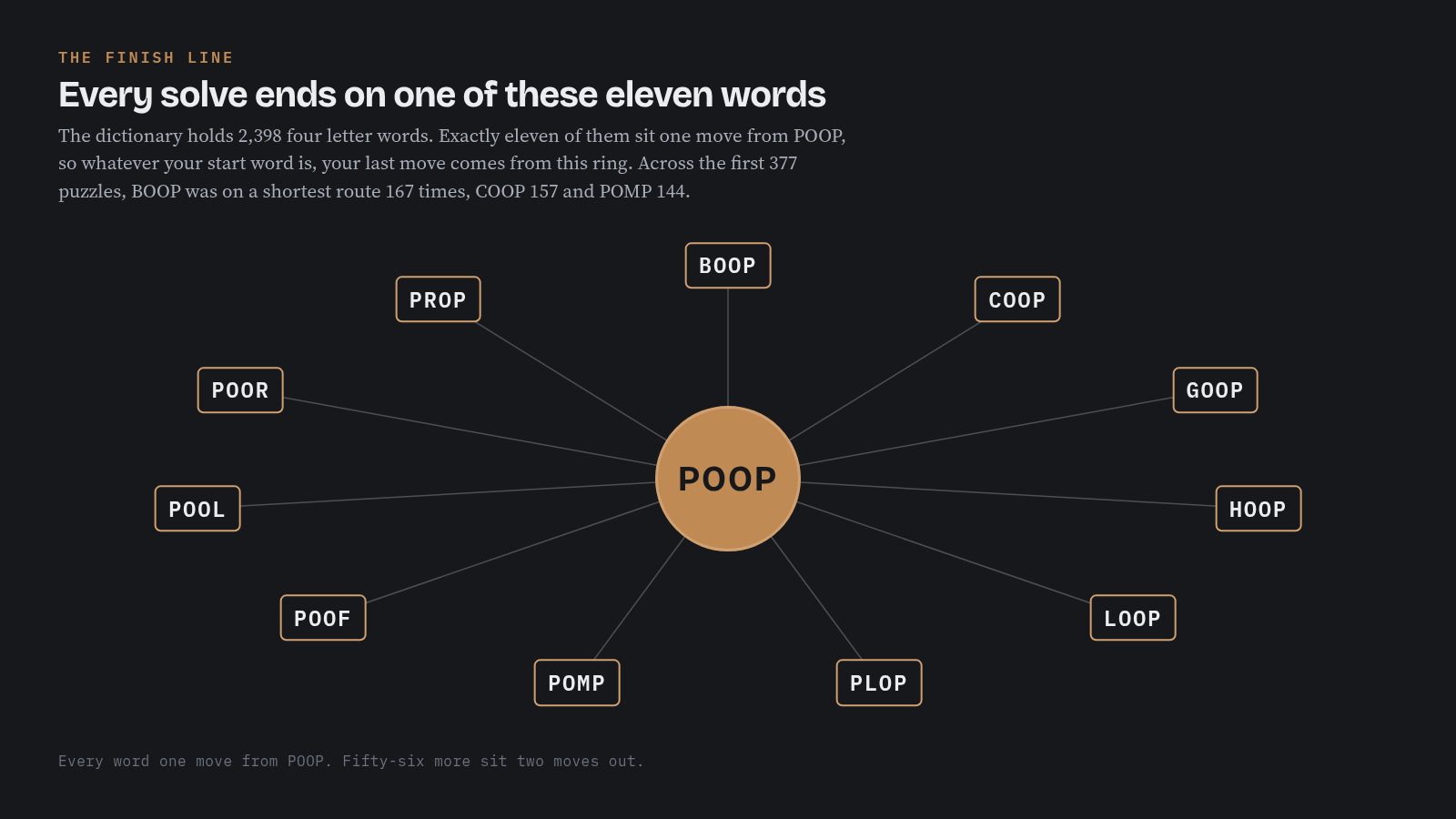
Work backward from POOP. The words that sit one step from POOP are BOOP, COOP, GOOP, HOOP, LOOP, PLOP, PROP, POMP, POOF, POOL, and POOR. Steering toward any of these in your final moves locks in the finish. COOP and LOOP make especially good approaches because they are well connected to the rest of the graph, so they are easy to reach from many positions.
Plan a bridge word. On harder puzzles, your starting word and POOP may live in different neighborhoods of the word graph. Look for a high-connectivity word that sits between your starting position and the POOP neighborhood. Reaching that bridge word first, then pivoting toward POOP, often produces the shortest path.
Aim for highly connected words. The word graph is not uniform. Some words have 20 or more legal one-letter neighbors, while others have only one. Moving toward a densely connected word keeps your options open and reduces how often your next move is forced on you. The hub words table in the next section identifies the most connected words in the dictionary.
The Hidden Graph: Connected Words
Every four-letter word in the dictionary can be thought of as a node in a graph. Two nodes are connected if they differ by exactly one letter. The game’s word graph contains 2,398 nodes. Some nodes sit at the center of the graph, with connections reaching in every direction. These are hub words, and they are excellent stepping stones.
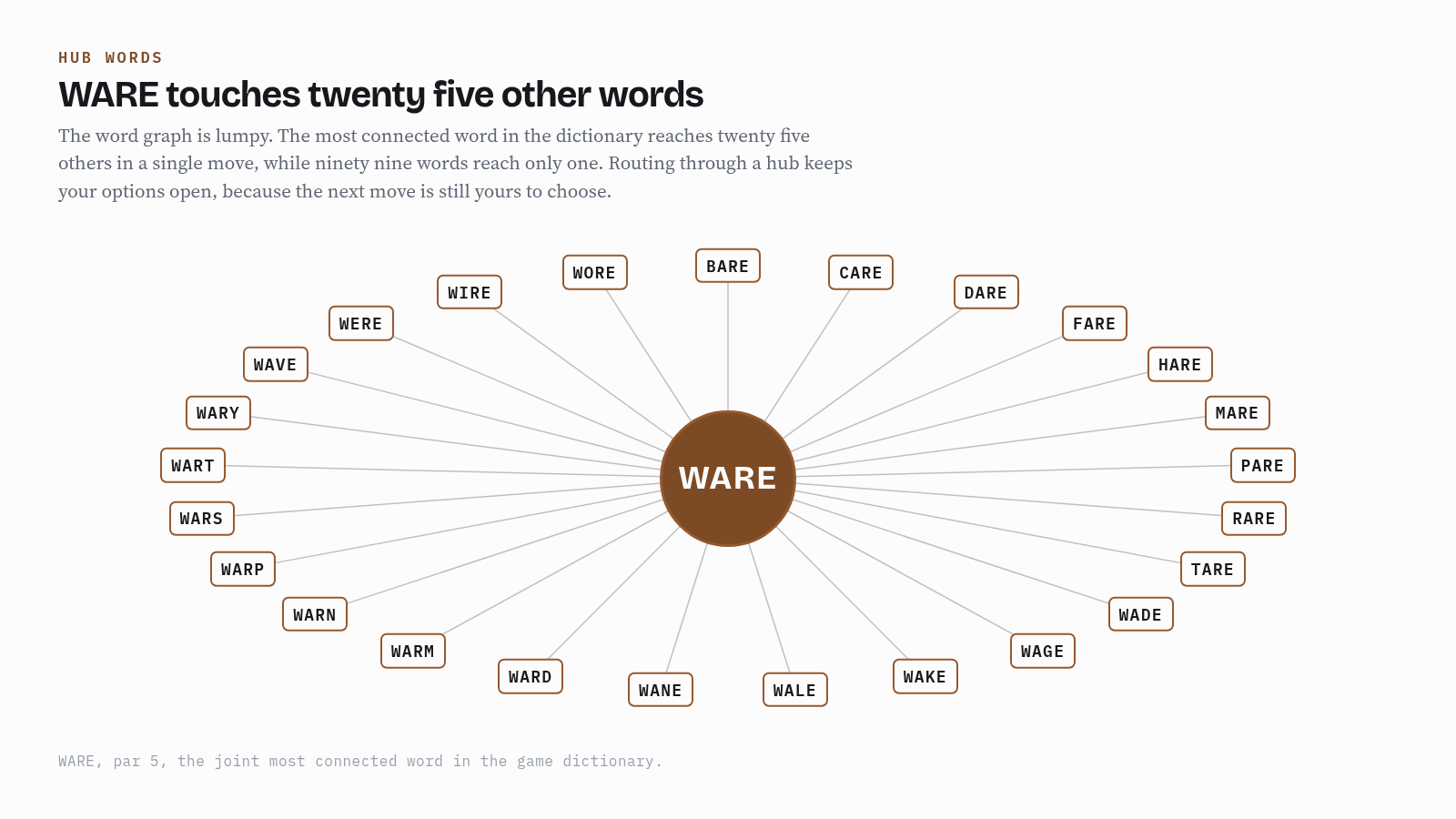
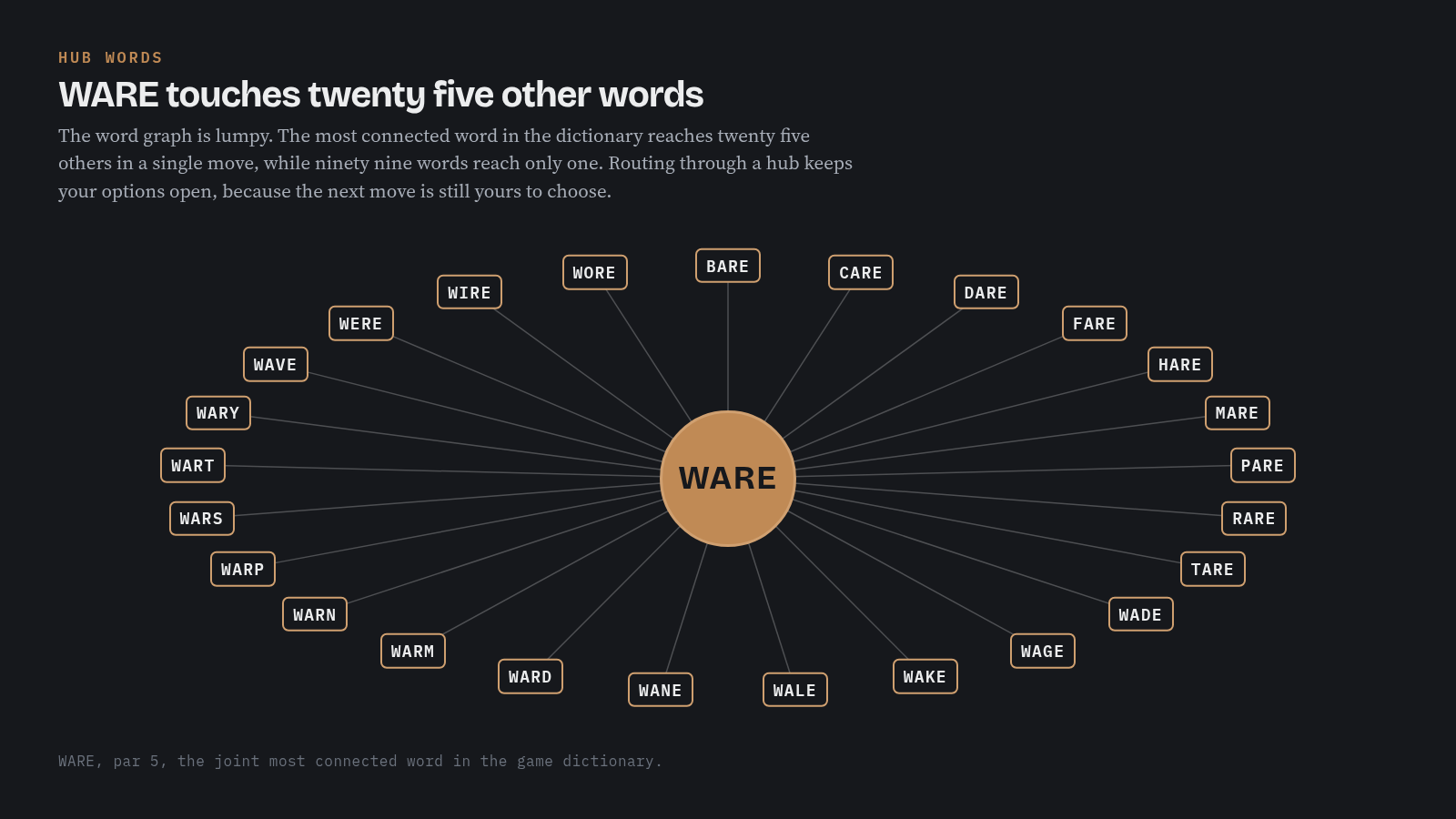
The table below lists the 15 most connected words in the game’s dictionary, along with their par (shortest path length to POOP). A lower par means you are already close; a higher par paired with many neighbors means the word is useful as an intermediate stop on a longer journey.
| Word | Neighbors | Par to POOP |
|---|---|---|
| PAPS | 25 | 5 |
| PATS | 25 | 5 |
| WARE | 25 | 5 |
| CARE | 24 | 5 |
| BARS | 23 | 5 |
| BOBS | 23 | 3 |
| CAPS | 23 | 4 |
| CARS | 23 | 5 |
| CORE | 23 | 4 |
| DINE | 23 | 5 |
| LINE | 23 | 5 |
| MALE | 23 | 5 |
| MARE | 23 | 5 |
| MINE | 23 | 6 |
| SAPS | 23 | 5 |
Notice that BOBS has only par 3. It can reach POOP in three steps and has 23 neighbors, making it one of the best pivot words in the entire graph. CORE and CAPS are also excellent: both sit at par 4 with 23 neighbors each, meaning they are close to POOP and densely connected. When you are stuck, ask yourself whether any of these words is reachable from your current position in one or two steps.
Dead Ends and the Hardest Words
Not every word is well connected. Exactly 99 words in the game’s dictionary have only one legal neighbor. Players call these dead ends, and the name is worth unpacking, because two different things get called by it.
The first meaning is a word with a single way out. There are 99 of those. The second meaning is a word that cannot reach POOP at all. There are zero of those, and that is true by construction: the dictionary was built by walking outward from POOP and keeping only the words that connect back to it.
The distinction changes the advice. Landing on a one-neighbor word costs you nothing at the moment you land on it. Checked across all 99, the single available move is always exactly one step closer to POOP, with no exceptions. It has to be. If the only way out led away from POOP, that word could never reach POOP at all, and every word in this dictionary reaches it.
What these words actually cost you is distance. The 99 one-neighbor words sit an average of 6.77 moves from POOP, against 5.02 for the dictionary as a whole. They are worth steering around because they tend to be far out to begin with, and because a forced move is a move you did not get to choose.
The hardest words are those with the highest par, meaning they require the longest optimal path to reach POOP. Any word at par 10 or above represents a genuine challenge.
| Word | Par |
|---|---|
| AUGH | 11 |
| INCH | 11 |
| UMPH | 11 |
| ALGA | 10 |
| AMEN | 10 |
| ARGH | 10 |
| IMPS | 10 |
| ITCH | 10 |
| ORCA | 10 |
| OXER | 10 |
| UMPS | 10 |
Three words share the maximum par of 11: AUGH, INCH, and UMPH. If one of these is the daily starting word, expect a lengthy ladder. The path still exists, and par is achievable, but it requires careful planning across more steps than usual.
Words like ORCA and ITCH land at par 10 because they sit in corners of the word graph with limited connectivity to the POOP neighborhood. Getting out of those corners requires at least one long traversal through the graph’s interior before you can close in on POOP.
Difficulty by Starting Letter
Because the word graph is not uniform, some starting letters put you much closer to POOP on average than others. The data below is computed across all words in the dictionary, grouped by first letter.
5 Easiest Starting Letters
| Letter | Average par | Words in dictionary |
|---|---|---|
| C | 4.12 | 158 |
| P | 4.22 | 185 |
| B | 4.39 | 184 |
| H | 4.62 | 122 |
| L | 4.64 | 143 |
5 Hardest Starting Letters
| Letter | Average par | Words in dictionary |
|---|---|---|
| U | 8.60 | 5 |
| A | 7.35 | 79 |
| Q | 7.33 | 6 |
| I | 7.32 | 19 |
| O | 7.19 | 42 |
Words starting with C, P, or B are on average only about 4 to 4.5 steps from POOP. That makes sense: POOP itself starts with P, and many P-words sit close to it in the graph. Words starting with U are the farthest away on average, at 8.60 steps, though only five U-words appear in the dictionary. A-words average 7.35 steps, driven partly by the cluster of difficult words like AUGH, ARGH, and AMEN.
If you notice the daily starting word begins with a letter from the hard group, plan for a longer ladder from the start.
A Short History
Word ladders were invented by Lewis Carroll in 1877. Carroll called the puzzle Doublets and published it in Vanity Fair magazine. The rules were the same as today: transform one word into another by changing a single letter at each step, keeping every intermediate word valid. The concept has endured for nearly 150 years and spawned dozens of variants, including Poople’s daily format with a fixed target.
Where to Go Next
Ready to put these strategies to work? Play today’s puzzle and see if you can match par. If you want more practice without affecting your daily streak, try Unlimited mode for as many random puzzles as you like.
When you are stuck mid-puzzle, the Word Ladder Solver can show you the shortest path from any four-letter word to POOP. Enter your current word as the start and check the output to find your next move or to see the full optimal route.
After the daily puzzle closes, the verified solution is published in the answers archive. Each entry shows the starting word, the par, and the shortest path. Browsing past answers is a good way to study how different types of paths unfold, especially for starting words in the difficult letter groups.
If you would rather read all of this away from a screen, The Poople Field Guide is a 17-page PDF covering the same ground in more depth, with five real puzzles worked through move by move: one with a single possible route, one where every rhyme is a trap, one with eighteen routes tied for shortest, and the two hardest openings the game has produced so far.