
Contexto asks you to find one hidden word, gives you unlimited guesses, and answers every one of them with a number. That number is the whole game, and most advice about it is guesswork.
So we took the guesswork out. Contexto publishes, for every puzzle it has ever run, the five hundred words nearest that day’s answer. We pulled all 1,421 of them, from puzzle 0 on 18 September 2022 to the puzzle for 8 August 2026, which is 710,500 ranked positions. Everything below comes out of that pile, and the counting rules are stated as we go so you can check any of it.
The short version: the words that appear most often are the words that help you least, the best openers are concrete nouns from crowded corners of English, and ten well-chosen words between them reach the top 100 on 60% of every puzzle ever published.
The Rules, Compressed
One secret word. Type any word, and Contexto tells you its position in a list of every word it knows, sorted by closeness to the answer. Position 1 is the answer and ends the game. Position 8,000 means you are nowhere. Guesses are unlimited and a bad one costs you nothing except the information you did not get.
The list is built from an algorithm that read a very large amount of ordinary text and learned which words keep company with which. That single fact explains almost everything strange about the game, and it is why the rest of this article is statistics rather than vocabulary. The mechanic itself, and how it sits next to Semantle and the other distance games, is already written up in games like Connections. This piece assumes you have the idea and gets straight to playing it better.
Watch a Full Contexto Solve
Fourteen guesses on the 8 August 2026 board, start to finish. The opening four are deliberately spread across unrelated subjects, which is the strategy the data below argues for, and two of the guesses in the middle are there to fail on purpose.
Video transcript
Contexto hides one word and gives you unlimited guesses. Each guess scores a position, and only position one wins. Open wide on purpose: a food, an animal, a place, a colour. All four land in the thousands. Water, at four ninety five, is the first real signal. Work, one, doctor: the numbers fall toward health. Needle is the obvious object, and it sits past seventeen hundred. Medicine scores eight. The idea lands where the object did not. Jab means exactly this, and comes back at eighteen sixty six. Shot means the same thing and comes back at two. Closeness follows how words get used, not what they mean.
The answer was VACCINE. Here is the finished board, sorted by position:
| Guess | Position |
|---|---|
| vaccine | 1 |
| shot | 2 |
| medicine | 8 |
| disease | 15 |
| one | 41 |
| doctor | 99 |
| work | 222 |
| water | 495 |
| needle | 1,709 |
| jab | 1,866 |
| blue | 1,903 |
| park | 3,009 |
| salad | 6,406 |
| frog | 6,786 |
Why Jab Lands at 1,866 and Shot Lands at 2
Look at those two rows again. In British English a jab is a vaccination. In American English a shot is a vaccination. They refer to the same event, and Contexto separates them by 1,864 places.
Nothing about meaning explains that. What explains it is that the text this algorithm learned from is overwhelmingly American, and in American text the words “vaccine” and “shot” appear beside each other constantly, while “jab” mostly turns up in boxing. The ranking is a measurement of company kept, and company kept is a property of the writing, not of the concept.
The same trap catches objects. NEEDLE, the thing a vaccine physically arrives on, sat at 1,709. SYRINGE would have been 1,805 and ANTIBODY, the actual biological mechanism, 1,327. Meanwhile MEDICINE, which is not a vaccine at all and merely lives in the same conversations, scored 8.
Solve a puzzle and Contexto will show you the whole ordering it was scoring against, which is where this article’s figures come from:
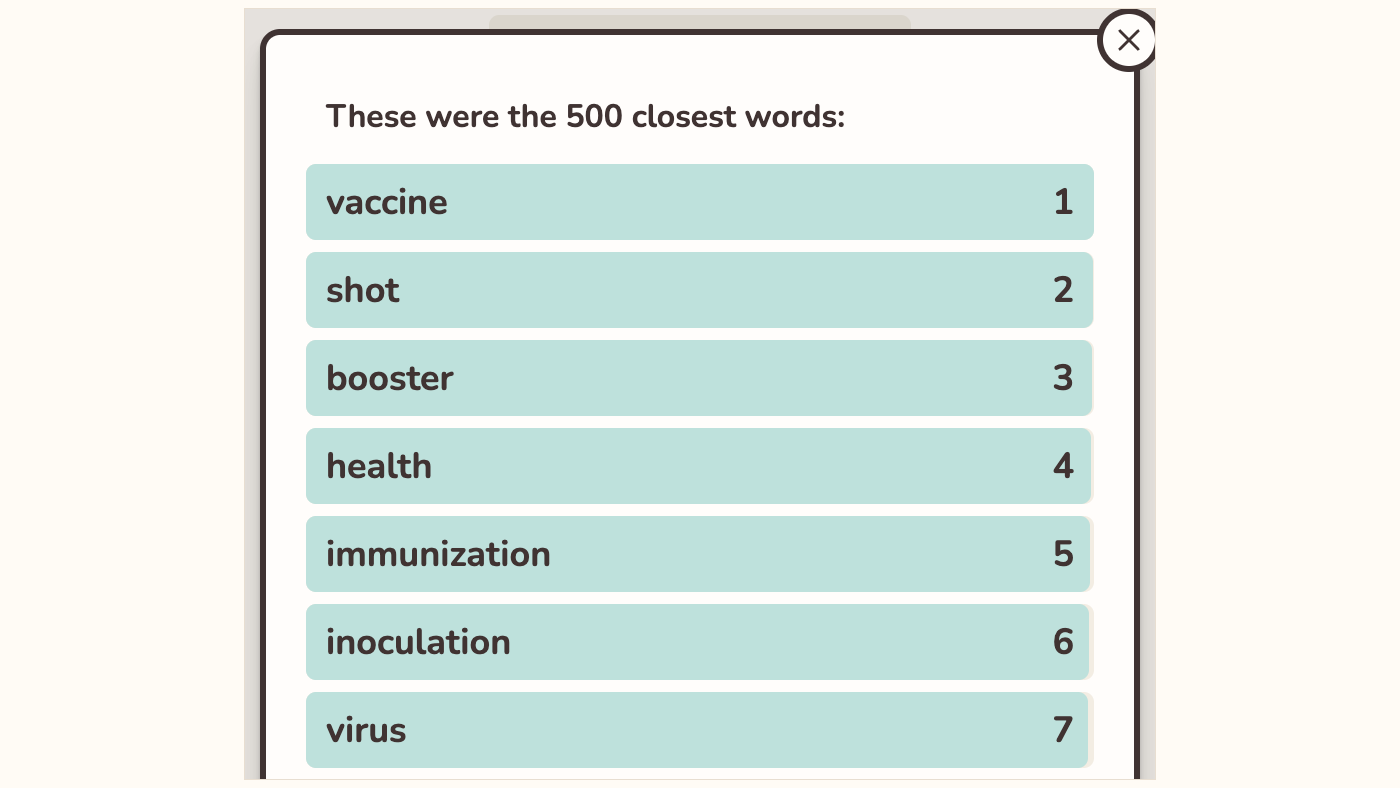
Read those first few rows as a description of the answer’s habitual company. SHOT, BOOSTER, HEALTH, IMMUNIZATION: these are the words that show up in sentences about vaccines. None of them is a definition.
Internalise this one habit and everything else gets easier. When you are stuck, stop listing things related to your best guess and start listing things that would appear in the same paragraph as it.
The Words That Show Up Most Are the Words That Help Least
Here is the obvious way to look for a good opening word: find the words that turn up in the most puzzles.
Across all 1,421 puzzles, the ten words that appear in the most top-500 lists are MAKE, ONE, WELL, COME, EVEN, LIKE, GO, PUT, BRING and MANY. MAKE appears in 845 of them, which is 59.5%.
Now look at where they land. MAKE has a median position of 216. ONE has 210. WELL has 215. Every one of the top twenty-five words by appearance has a median in the low two hundreds, and their middle-half ranges are all roughly 110 to 350.
A word that comes back at 216 out of 500 has told you almost nothing. It is the numeric equivalent of a shrug. These words sit at the same middling distance from nearly every answer in the game, which is exactly why they appear so often and exactly why they are useless.
Appearing often and being informative are two different properties, and only the second one is worth optimising for.
What a Good Opening Word Actually Looks Like
Change the question. Instead of asking how often a word appears at all, ask how often it comes back inside the top 100, which is close enough to actually steer the next guess.
The generic verbs still sit near the top there, because appearing 845 times gives you a lot of chances. But something else appears alongside them:
| Word | Lands in top 100 | Appears at all | Median position |
|---|---|---|---|
| one | 191 puzzles | 829 | 210 |
| well | 179 | 815 | 215 |
| salad | 133 | 201 | 68 |
| cheese | 130 | 213 | 76 |
| bake | 118 | 216 | 83 |
SALAD appears in only 201 puzzles, a quarter as often as ONE. But when it does appear, its median position is 68 rather than 210. It is quiet most days and loud on the days it matters.
Tighten the threshold to the top 25 and the generic words fall away entirely. The ten words most likely to land inside the top 25 are FISH, POTATO, ANIMAL, CHEESE, BUTTER, CHICKEN, BIRD, CHOCOLATE, BAKE and DESSERT.
That list is not a coincidence and it is not about those particular words. It is a fact about the answer set: Contexto leans heavily on food and animals, so a probe aimed at either of those regions pays off far more often than its overall appearance rate suggests.
Ten Words That Cover 60% of Every Puzzle
A ranked list is still the wrong shape of advice, because the best openers overlap. POTATO, TOMATO and ONION all fire on the same food days, so playing all three teaches you barely more than playing one.
The right question is which small set of words between them reach as many days as possible. That is a set cover problem, and the standard greedy method answers it: repeatedly take the word that reaches the most days nothing has reached yet.
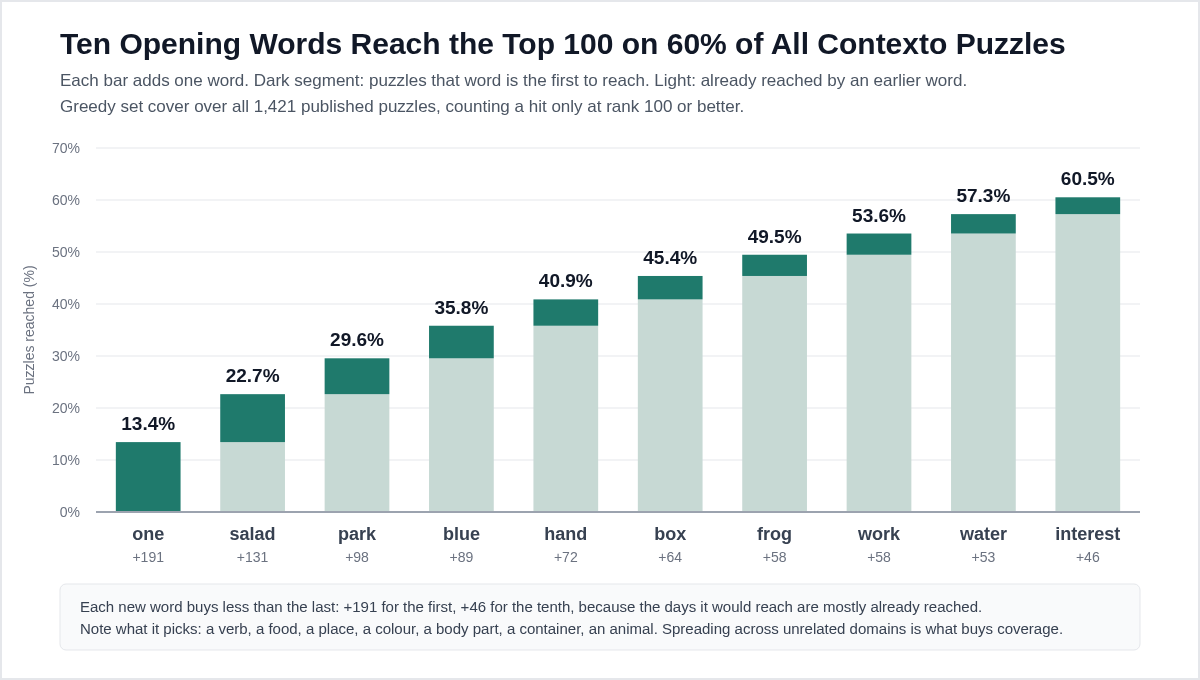
| Pick | Word | New days reached | Running total |
|---|---|---|---|
| 1 | one | 191 | 13.4% |
| 2 | salad | 131 | 22.7% |
| 3 | park | 98 | 29.6% |
| 4 | blue | 89 | 35.8% |
| 5 | hand | 72 | 40.9% |
| 6 | box | 64 | 45.4% |
| 7 | frog | 58 | 49.5% |
| 8 | work | 58 | 53.6% |
| 9 | water | 53 | 57.3% |
| 10 | interest | 46 | 60.5% |
Ten words, 860 of 1,421 puzzles, 60.5%.
The composition of that list is the actual lesson. A generic verb, a food, a place, a colour, a body part, a container, an animal, an abstract noun, a substance, another abstract. Nobody chose that spread. The algorithm was told only to maximise coverage, and maximising coverage forced it to jump between unrelated regions of the language on every pick.
Note also how fast it flattens. The first word buys 191 days, the tenth buys 46. Adding an eleventh food word to a list that already has SALAD buys almost nothing.
Against the advice that is already out there
The most detailed opening-word guide currently ranking for this game is WordFinder’s, and its central idea is sound: cover categories rather than chase specific words. The words it names are the problem.
It recommends opening with PERSON, PLACE, THING, IDEA and CONCEPT, then FOOD, OCCUPATION, ANIMAL and EVENT, then CITY, NATURE, HOME, WORK and TECHNOLOGY. Running those fourteen against the archive:
| Set | Words | Reaches top 100 |
|---|---|---|
| PERSON, PLACE, THING, IDEA, CONCEPT | 5 | 19.8% of puzzles |
| All fourteen above | 14 | 39.5% |
| The ten in the table above | 10 | 60.5% |
PERSON, the very first recommendation, lands inside the top 100 on 9 of 1,421 puzzles, which is 0.6%, with a median position of 310. OCCUPATION turns up in the top 500 at all on 11 days out of 1,421.
The reason is the same one that sinks MAKE and ONE. Category labels are abstract, and abstract words keep company with everything and with nothing in particular. POTATO looks like the narrower, weaker guess next to FOOD, and it measures as the far stronger one: it reaches the top 25 on 48 days against FOOD’s 29.
What the Answers Are Like
Three facts worth carrying into a game.
Answers are short and ordinary. The median answer is 6 letters, the middle half runs 5 to 7, and the full range is 2 to 13. Roughly 58% of all answers are 4, 5 or 6 letters.
Answers almost never repeat. Across 1,421 puzzles there are 1,419 distinct answers. Exactly two have been used twice: FIREWORK, on 3 December 2024 and 5 June 2026, and GLASS, on 5 November 2022 and 7 February 2025. If you think you have seen today’s answer before, you almost certainly have not.
Answers sit in busy neighbourhoods. Take each answer and count how many other puzzles it turns up in the top 500 of. The median is 77, about 5.4% of the archive. The most connected answers are WAY (638 other puzzles), WORK (564) and HAND (482). At the other end, SEQUOIA appears in 2, DRUPE in 1, and both STY and ANCHORMAN in none at all. Those are the days you should expect to grind, and there is no shame in it.
Yesterday Tells You Nothing
It is tempting to carry a warm word from yesterday into today. The numbers say do not bother.
Comparing each puzzle’s top 500 with the next day’s, across all 1,420 consecutive pairs, the median overlap is 3.1%. That works out at about 30 words in common out of 500. The two boards share nothing whatsoever on 44 of those pairs, and even the most similar pair in four years only overlaps by 36%.
Every day is a fresh draw. The only thing worth carrying over is the method.
Two Things About Typing That Are Not Obvious
Inflections collapse, derivations do not. Type VACCINES and Contexto scores it as VACCINE. Type VACCINATED and it scores it as VACCINATE. But VACCINATE is a different word from VACCINE, and on the board above it sat at position 63 while VACCINE was position 1. Plurals and tenses cost you nothing to try. Related word forms are genuinely separate guesses.
This also means the top of a list is often padded with the answer’s own relatives. About 23% of puzzles have at least one word sharing the answer’s first four letters somewhere in positions 2 to 10. When you land inside the top ten, spending a guess on a different form of that word is frequently worth it.
Two kinds of rejection exist. Common function words come back as “This word doesn’t count, it’s too common”, which is what THE, OF and AND all produce. A rejected word is not scored and does not raise your guess count.
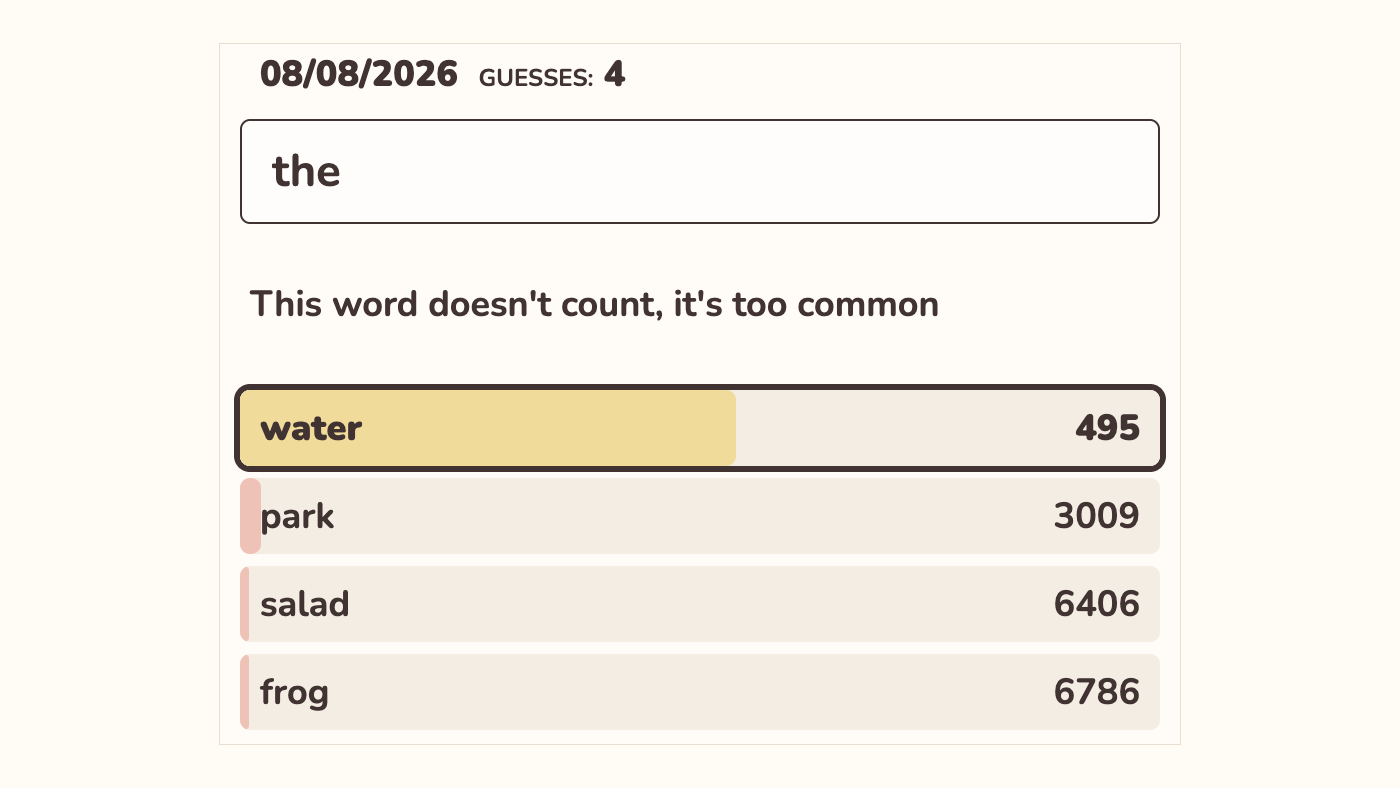
Separately, a small number of ordinary words come back as simply “This word doesn’t count” with no reason attached, DRUG among them. That second list is short and undocumented, so if a perfectly normal word bounces, move on rather than assuming you typed it wrong.
Contexto Tips That Follow From the Data
Open with four or five concrete nouns from unrelated subjects. Food, animal, place, body part, container. This is what the set cover does, and it is the highest-value habit in this game. Four cold answers still eliminate four large regions.
Do not open with verbs. MAKE, GO, PUT and their relatives come back in the low hundreds almost regardless of the answer. They feel like progress and are not.
Treat 500 as the real cutoff. Anything worse tells you the region is wrong. Anything inside tells you the region is right, and how far inside tells you how right.
Once you are inside the top 100, stop thinking about meaning. Ask which words would appear in the same paragraph, not which words mean something similar. That is what put MEDICINE at 8 while NEEDLE sat at 1,709.
Try the other word form. Plurals cost nothing. Different parts of speech are separate guesses and are often close.
Try the casual register. SHOT beat JAB by 1,864 places. When a formal term stalls, the everyday word for the same thing is a genuinely different guess.
A Note on These Numbers
Everything here comes from the 500-word lists Contexto publishes for its own past puzzles, read once through its public endpoint. The puzzle data itself is not reproduced anywhere on this site. All that was kept are the counts.
One check is worth mentioning because it could have invalidated the rest. The archive spans nearly four years, and the ranking behind it comes from a model nobody outside Contexto can version. If it had been retrained partway through, a position in 2022 and a position in 2026 would not be the same measurement and none of the totals above would mean anything.
So before computing anything we measured what the data looks like when the model definitely has not changed: split a single year in half by alternating puzzle, and compare the two halves. That baseline came out at 0.754 overlap, with the weakest single year at 0.587. Comparing consecutive years, using samples of the same size, the lowest figure was 0.493.
That is lower than the baseline, and worth being precise about. It is not evidence of a retrained model, because the years that produce the lowest cross-year figures are the same years whose own two halves agree least, which is what a noisy year looks like rather than a break. It cleared the threshold set before the test was run, so the archive is treated here as one continuous stretch. Had it not, everything above would have been restricted to a shorter window and this section would say which one.
Frequently Asked Questions
How does a Contexto game work?
One word is hidden. Each guess is answered with its position in a list of every word the game knows, ordered by closeness to the answer, where position 1 is the answer itself. Guesses are unlimited and wrong ones cost nothing except information.
What is the best starting word for Contexto?
No one word is best, and the ones most often recommended are the worst kind. Words like MAKE and ONE appear in more than half of all puzzles but land at a median position around 215, which tells you nothing. Open instead with four or five concrete nouns from unrelated subjects. Ten such words, chosen to overlap as little as possible, reach the top 100 on 60.5% of all 1,421 published puzzles.
Why is my synonym so far away?
Because position measures how often two words appear in similar company in ordinary writing, not how close their dictionary definitions are. On the puzzle above, JAB, which means exactly the answer, came back at 1,866, while SHOT came back at 2. Both are correct English for the same thing. Only one of them keeps company with the answer in the text the algorithm learned from.
What is a good Contexto score?
Fewer guesses is better, and the game shows you how many of yours landed near, middling and far. Fourteen guesses on a puzzle whose answer sits in a crowded region is unremarkable. On a day like SEQUOIA or DRUPE, whose answers appear in the top 500 of only two other puzzles and one other puzzle respectively, a much longer game is normal.
Does Contexto repeat answers?
Almost never. Across 1,421 puzzles there are 1,419 distinct answers, and only FIREWORK and GLASS have been used twice.
Do plurals count as different words in Contexto?
No. Plurals and tenses are reduced to their base form, so VACCINES scores identically to VACCINE. Different word forms are another matter: VACCINATE is a separate word from VACCINE and scored 63 on a board where VACCINE was 1.
Can you play past Contexto puzzles?
Yes, and free. Every previous puzzle is open to anyone at its own dated address, which is unusual among daily word games and is what made these counts possible.
Where to Go Next
Semantle, Pimantle and the wider distance family are covered in games like Connections, alongside the grouping games. To browse everything at once, the full directory of daily -dle games sorts them by category with a difficulty rating on each.
For feedback shaped like a path instead of a number, our own daily word ladder hands you two words and one letter to change at a time.