
Connections gives you sixteen tiles and asks which four of them belong together, and then asks it three more times. The rules fit in a sentence. Almost nothing about actually playing it does, because the difficulty lives in how the board is assembled rather than in how the controls work.
What follows is the rule set the game actually applies, a solve recorded end to end, and one worked example of the specific way Connections sets a trap. Then it goes somewhere the other guides do not: we pulled 180 consecutive daily puzzles from the New York Times and counted what is in them, because “the purple group is harder” is something every guide repeats with no number attached to it.
What Is Connections?
It is a daily grouping puzzle from The New York Times, edited by Wyna Liu, published fresh every day at midnight local time. One puzzle per day, free, no account needed to play the current one.
The board is four rows of four. All sixteen tiles belong to exactly one of four hidden groups, and the whole game is deciding which. There is no typing, no letter feedback and no vocabulary requirement. Every word on the board is a word you already know, which is precisely what makes it hard: the difficulty is never the words, it is the sorting.
The Rules of Connections
- Tap or click four tiles to select them. Selected tiles darken.
- Press Submit. If those four are a real group, they lock into a coloured band above the remaining tiles and leave the grid.
- If they are not a group, you lose one of four lives and the selection clears.
- Solve all four groups before running out of lives.
Two mechanics are worth knowing before your first game, because neither is announced:
“One away” is a real signal. Submit a group with exactly three correct tiles and the game tells you so. It will not tell you which three. This is the most valuable feedback in the game and it only appears when you are wrong, which is a reason to submit a considered guess rather than sit on a board forever.
Shuffle is free. The Shuffle button rearranges the tiles and costs nothing. Reading the same sixteen words in a fresh arrangement genuinely helps, because the grid layout suggests groupings that are not there.
How Many Mistakes Do You Get?
Four. The game shows four dots labelled “Mistakes remaining” and removes one per wrong submission. When the last dot goes, the puzzle ends and the answers are revealed. So three wrong guesses still leave you able to finish, and the fourth is the one that ends the game.
That is how to play Connections, in full. Everything from here answers the harder question the rules leave alone, which is how a board gets built to mislead you.
Watch a Full Connections Solve
Below is puzzle #1235, the Connections for August 5, 2026, solved from an empty board to a finished one. It was captured live in a browser, runs about twenty nine seconds, and carries narration plus captions. Watch how each correct submission collapses into a coloured band, and note the order those bands arrive in, which is covered directly below.
Video transcript
Connections gives you sixteen tiles hiding four groups of four. Select four, hit Submit, and a correct group locks in. A fourth wrong guess ends the game, so lead with what you are sure of. Yellow is meant to be the easiest group and purple the hardest. Purple almost always hides wordplay. Here, STOCK meant broth, cattle, investment, merchandise.
Reading the Four Groups
Here is what that board held, with the colour the game assigned each group:
| Submitted | Group | Colour | Tiles |
|---|---|---|---|
| 1st | JEANS BRANDS | Green | DIESEL, GAP, LUCKY, WRANGLER |
| 2nd | HOUSE STYLES | Blue | CAPE COD, MISSION, RANCH, TUDOR |
| 3rd | NAVIGATE | Yellow | DRIVE, MANEUVER, PILOT, STEER |
| 4th | WHAT “STOCK” MIGHT REFER TO | Purple | BROTH, CATTLE, INVESTMENT, MERCHANDISE |
The colours rank difficulty: yellow is the group the editor considers easiest, then green, then blue, then purple. Notice that the solve order in the video does not follow that ranking. Green went first, yellow went third.
That is normal, and it is worth understanding why rather than treating it as a mistake. Proper nouns feel safe. Four denim brands are four denim brands, and a tile reading WRANGLER has very few other jobs it could be doing. A synonym group like NAVIGATE feels riskier even though the game rates it easiest, because ordinary verbs can be recruited into almost anything. Solve order should follow your own confidence, and confidence tracks how few alternative homes a tile has.
The Trap Hiding on That Board
Look at the four groups again and something jumps out. CATTLE sits in the purple group. STEER and DRIVE sit in yellow. RANCH sits in blue.
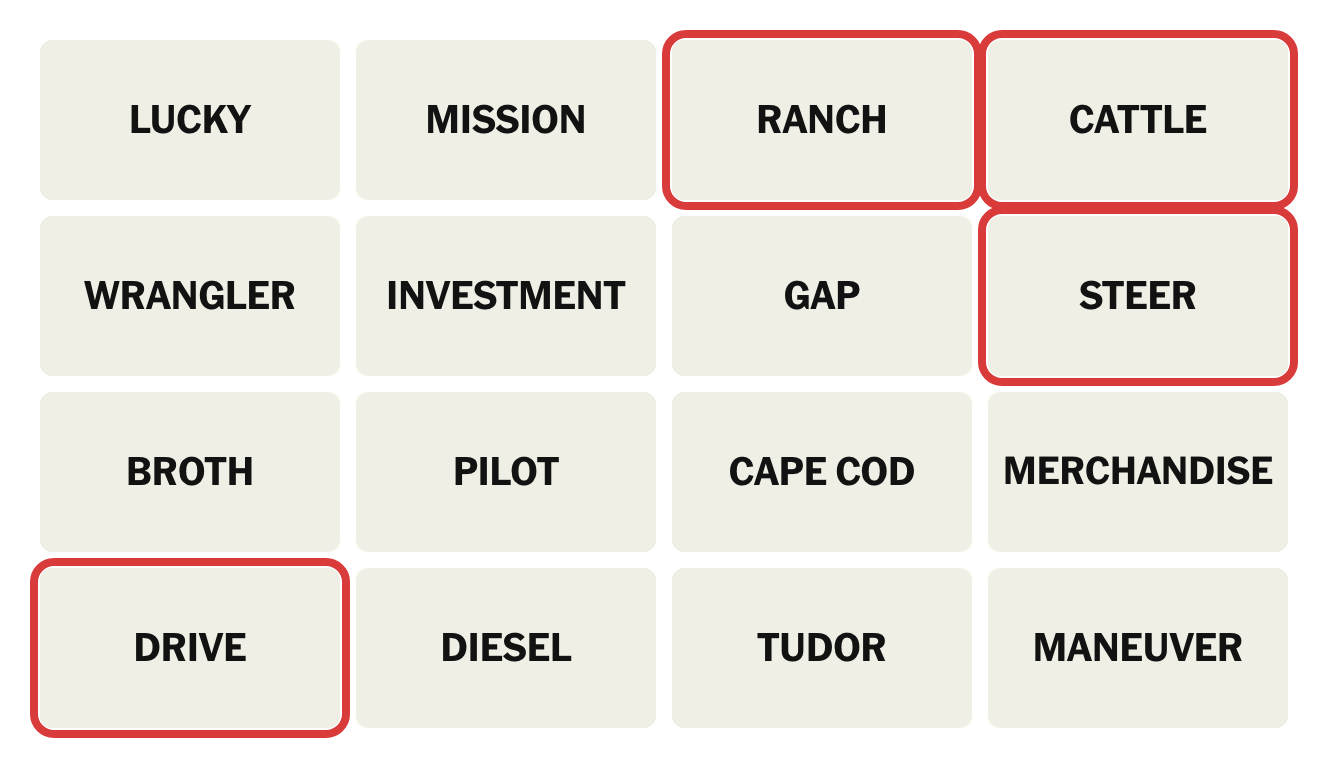
Those four tiles make a completely coherent group. A steer is cattle, a cattle drive is a thing, a ranch is where it happens. If you had submitted CATTLE, STEER, DRIVE and RANCH you would have lost a life to a group that looks more convincing than the real ones, and you would have been pulling one tile out of each of the three other categories at once.
This is the standard Connections construction, and once you can see it you can defend against it. A theme that is obviously present on the board is usually the decoy. The editor knows that “these are all cattle words” is the first idea a reader will have, and the puzzle is built so that idea costs you. The real groups were a brand list, an architecture list, a synonym list, and one word wearing four meanings.
The practical rule: when four tiles form a tidy theme immediately, count how many of the remaining twelve could also join it. If the answer is several, you have found the trap rather than the group.
What 180 Puzzles Show About How the Boards Are Built
Everything above is one board. To say anything general we fetched 180 consecutive daily puzzles, February 6 to August 4, 2026, straight from the endpoint the game’s own front end loads them from, and counted. That is 720 categories and 2,880 tiles.
Four of those days are “picture edition” puzzles where some tiles are images rather than words. They are dropped whole from any count about words, leaving 176 puzzles and 704 categories for those figures. Two scripts in our repo produce every number below, so all of it can be re-derived rather than taken on trust.
One disclosure before the numbers. Grouping category titles into types is our classification, not one the New York Times publishes. The rules are a set of regular expressions matched against the title text, they are written down in the script, and they are the entire definition. Where the rules are known to undercount, that is said.
The Purple Group Is Usually Not About Meaning
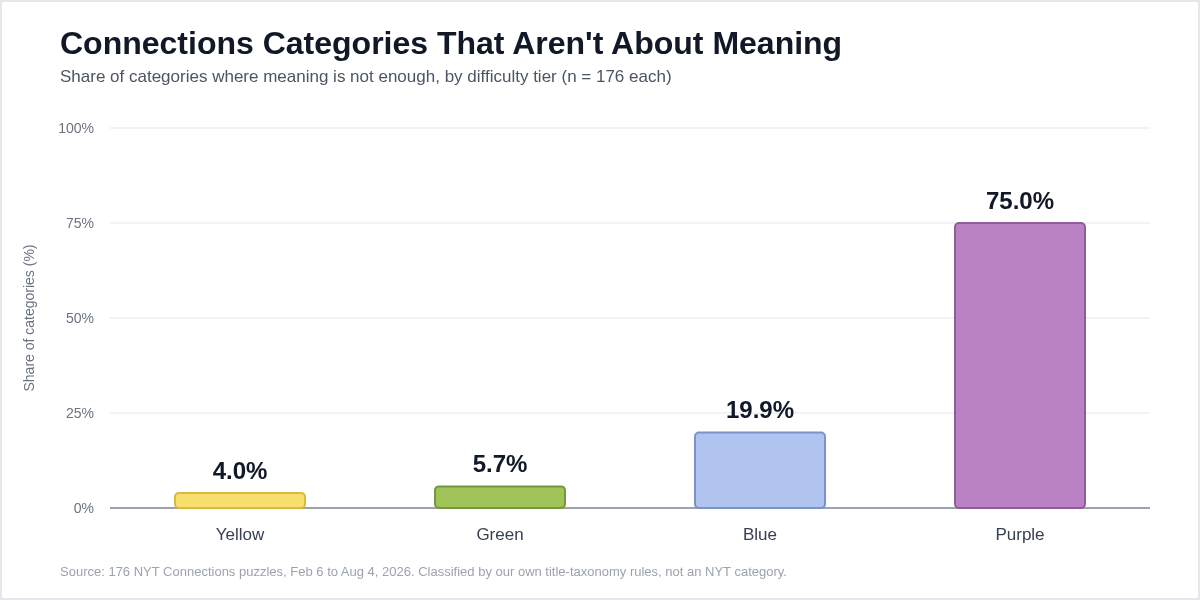
The most useful finding is also the simplest. Sorting all 704 category titles by whether they are about what words mean or about how words are spelled, and then splitting by difficulty tier:
| Difficulty | Categories where meaning is not enough | Share |
|---|---|---|
| Yellow | 7 | 4.0% |
| Green | 10 | 5.7% |
| Blue | 35 | 19.9% |
| Purple | 132 | 75.0% |
Three quarters of purple groups are not asking what the words mean. Look only at outright letter games, the anagrams and homophones and “starting with” constructions, and the split is starker still: 77 of 176 purple categories, against 4 of 176 yellow ones. That is 43.8 percent versus 2.3 percent.
Real purple titles from the sample give the flavour: FISH MINUS A LETTER. CAR BRANDS PLUS TWO LETTERS. HOMOPHONES OF RELIGIOUS ROLES. U.S. AIRPORT CODES PLUS STARTING LETTER. And, on July 11, DOUBLE LETTERS APPEARING IN THAT LETTER’S ALPHABETICAL POSITION.
The playable consequence is direct, and it is the single most useful thing in this article. When you are down to the last four tiles and they refuse to mean anything together, stop looking for a meaning. By the odds, that group is testing spelling, sound, or a word with more than one sense. Read the tiles letter by letter. Say them out loud. Ask what each one could mean in a context you have not considered.
Both counts are floors rather than ceilings, because a rule that reads titles cannot catch wordplay the title never mentions. WHAT “SPRING” MIGHT REFER TO is a purple category about one word carrying four unrelated senses, and no pattern about letters will flag it. Thirteen such titles appear in the sample, eleven of them in purple. The recorded solve above ended on exactly this kind: WHAT “STOCK” MIGHT REFER TO.
The Words That Keep Coming Back
Counting every tile across 176 plain-text puzzles, 62 words appear three or more times. The top of that list:
| Tile | Appearances |
|---|---|
| CHECK | 6 |
| HORSE | 5 |
| KEY | 5 |
| BENCH, FLY, HEAD, LEAD, MOTHER, PIPE, PITCH, POKER, RING | 4 each |
The counts are mechanical. What they have in common is an observation, so treat it as one: almost every word on that list carries an unusual number of unrelated meanings. CHECK is a bank draft, a chess position, a tick mark, a restaurant bill and a plaid pattern. KEY opens a door, sits on a piano, explains a map, names a musical scale and is a small island. PITCH is a throw, a sales talk, a musical frequency, a sports field and a kind of tar.
That is the whole mechanism of the game in one table. A word with five unrelated senses can be recruited into any of the five, which makes it useful to an editor building a board where tiles have to look like they belong somewhere they do not. The tiles that recur are the tiles that can lie.
Useful in practice: when a very ordinary short word turns up on a board, it is more likely to be load bearing than decorative. HORSE showing up in front of you is a hint that some group needs its second or third meaning.
The Grid Is Scattered on Purpose
Every tile carries its board position, so we could check whether members of a group are spread out more than chance would spread them. Measuring the average distance of a group’s four tiles from their own centre, across all 720 categories, gives 1.3775 grid cells. Working out the same figure for all 1,820 possible ways to place four tiles on a sixteen cell grid gives 1.3112.
Bunched and scattered, drawn at their extremes, look like this:
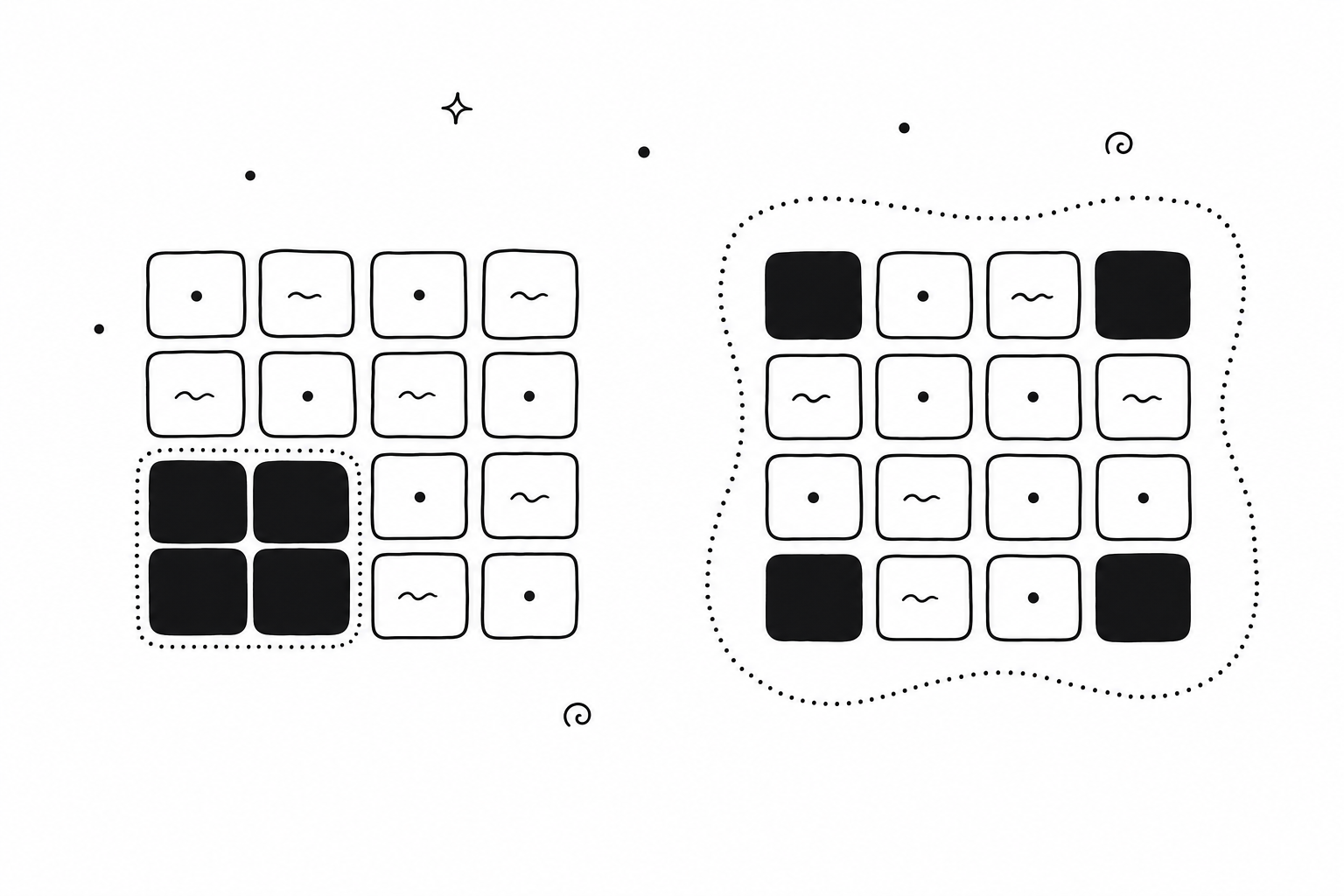
The corpus sits about 5 percent more spread out than random placement. That gap is small, so the question is whether it is real: a one sample z-test against the exact random baseline gives z = 8.75, far past any conventional significance threshold. The effect is genuine, and it is also slight.
That is precisely why Shuffle earns its place. Group members sit a little further apart than chance would put them, so any grouping the layout seems to propose deserves suspicion, and rearranging costs nothing.
One more number, reported because a null result is still a result: Wyna Liu is credited as editor on all 180 puzzles in the sample.
Connections Strategy That Works
- Start with proper nouns. Brand names, place names and titles have the fewest alternative homes on a board. That is the reason the video’s solve opened with a denim group.
- Find the fourth tile before you submit. Three tiles that clearly belong together are not a group. The whole game is played in the gap between the third and the fourth, and submitting on three plus a hopeful guess is how lives disappear.
- Treat an obvious theme as suspect. If a theme is easy to see, assume the editor saw it too and built around it. Count how many tiles could plausibly join before you commit.
- Press Shuffle when you stall. The layout is nudged against you, and re-reading the same words in a new arrangement is free.
- Save the group you cannot explain for last. If four tiles are left over and refuse to cohere, that is the purple group behaving normally, and it is probably about letters or a second meaning.
- Use “one away” rather than resenting it. It tells you three of your four were right, which usually means swapping one tile against the tile you were least sure of.
Frequently Asked Questions
How do you play Connections?
Select four of the sixteen tiles that you think share a category and press Submit. A correct set locks in as a coloured row and leaves the board. A wrong set costs one of your four lives. Clear all four groups before the lives run out.
How many mistakes do you get in Connections?
Four. Each wrong submission removes one of the four “Mistakes remaining” markers, and the puzzle ends when the last one goes, so three wrong guesses still leave you able to finish.
What do the colours mean in Connections?
They rank difficulty as the editor judged it: yellow easiest, then green, then blue, then purple hardest. You do not see a group’s colour until you solve it. In our 180 puzzle sample the ranking corresponds to a real difference in kind, since 75 percent of purple categories turn on something other than what the words mean, against 4 percent of yellow ones.
Why is the purple group so hard?
Because it is usually a different type of puzzle. Purple leans heavily on anagrams, homophones, hidden words, “starts with” constructions, and single words carrying several unrelated senses. Trying to solve it by asking what four words have in common semantically is often the wrong question entirely.
Is Connections free?
The current day’s puzzle is free in a browser and no sign-in is needed. Signing in saves your streak. Everything published before today sits behind the NYT Games paywall.
Can you play past Connections puzzles?
Only if you subscribe to NYT Games, which opens the back catalogue. Several independent sites run their own grouping puzzles with open archives if what you want is a backlog to work through.
Where to Go Next
If the sorting is the part you enjoy and a single board per day leaves you wanting more, our roundup of games like Connections covers ten daily puzzles organised by which part of the experience you are chasing, several of them with open archives. The wider dle games directory is the place to browse by category.
If what you actually liked was the daily rhythm rather than the grouping, Poople runs a word ladder with a fixed destination. Every morning hands you a fresh opening word and the same four-letter finish, POOP, and each step in between swaps exactly one letter for another while staying inside the dictionary. Play today’s puzzle, or drill on back-to-back boards in Unlimited mode. Weaver plays by similar rules with a different target daily, and our guide to playing Weaver has a recorded solve of its own.