
Every Strands puzzle hides one answer that behaves differently from the others. It is called the spangram, it names the theme outright, and the game will tell you it stretches clear across the grid from one side to the side facing it. What the game does not tell you is which pair of sides, how reliably, or why one direction shows up far more often than the other.
So we pulled the archive. Every Strands puzzle published between 4 March 2024, the day the game launched, and 5 August 2026, which is 885 puzzles, and measured the board geometry on all of them.
The short version: the edge rule has never once been broken, the spangram favours the side edges by 59% to 36%, and on the 674 puzzles where the data lets us check it, roughly two thirds of spangrams are strings you will never find in a dictionary. What follows covers how to play Strands, a recorded solve of a real puzzle, and what the archive says about the board in front of you.
What Is Strands?
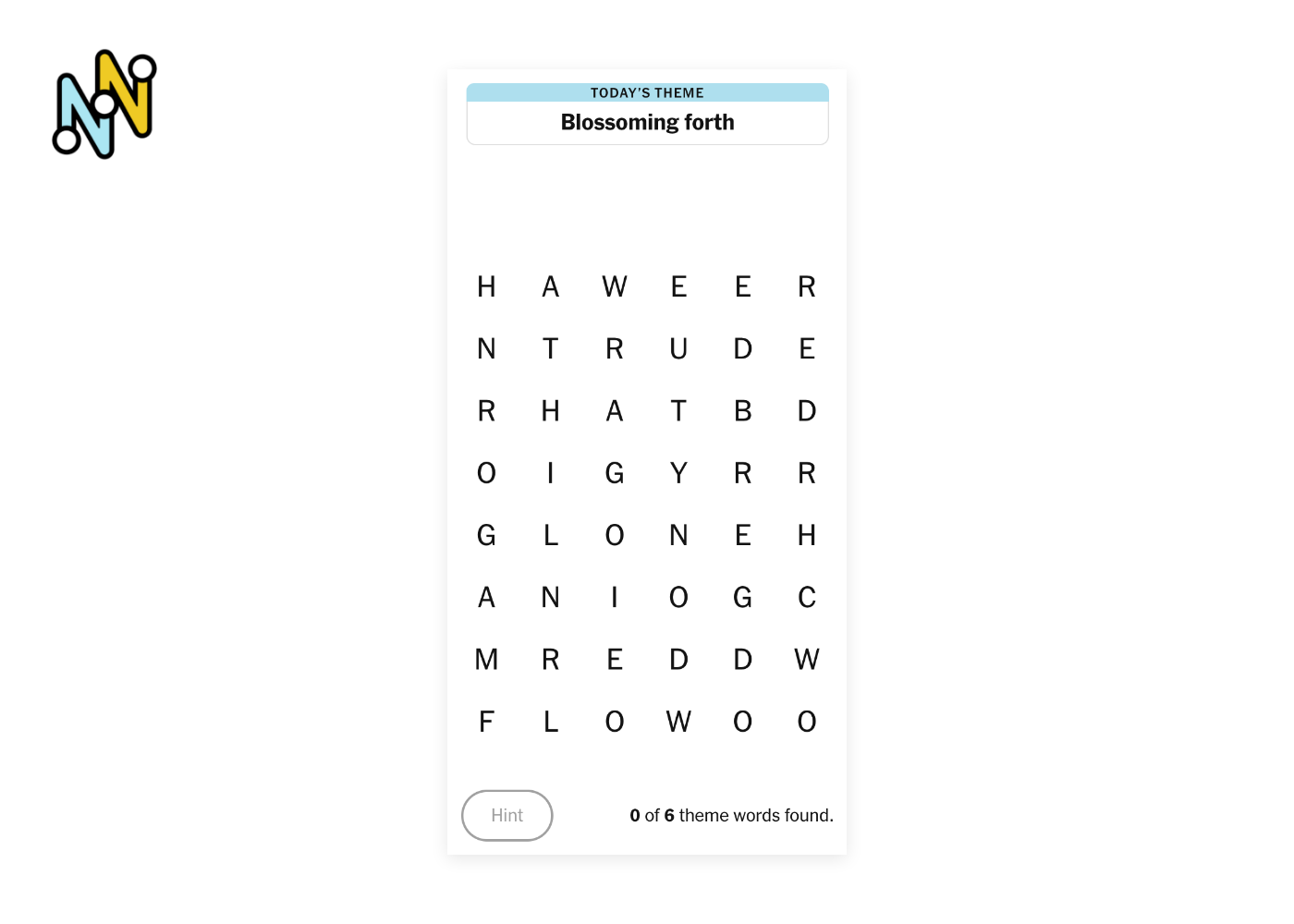
Strands is The New York Times word search with a theme layer on top. You get a grid of loose capital letters, six columns across and eight rows down, and a short clue at the top. Hidden in that grid are several words that all fit the clue, plus the spangram.
It launched in March 2024 and sits alongside Wordle, Connections and the Mini in the NYT Games lineup. You can open the daily puzzle in any browser without signing in and without paying.
The Rules of Strands
Trace a word by dragging through letters that touch, including diagonally, then click the last letter a second time to submit it. Correct theme words lock in and stay highlighted.
Four things are worth knowing before you start:
- There is nothing to lose. No guess limit, no timer, no strike counter. A wrong attempt simply does not register.
- Every letter is used exactly once. The theme words and the spangram together cover all 48 cells with no leftovers and no overlaps. We checked this on all 885 archived puzzles and it held every time. Once a word locks in, those cells are gone from the pool.
- Off-theme words are useful. If you trace a legitimate English word that is not part of the theme, it does not count against you and it does not count as an answer. It advances a meter. Three of them unlock one hint.
- A hint reveals a whole word. Spending one lights up every letter of a theme word you have not found yet, without connecting them for you.
What Is a Spangram?
The spangram is the answer that names the theme. It is highlighted in a different colour from the theme words when you find it, and it is the only answer guaranteed to reach across the board from one edge to the edge facing it.
It is also the longest thing on the board most of the time. Across the archive the average spangram runs 10.0 letters against an average theme word on the same board of about 6.3, a gap of 3.65 letters.
One detail that trips people up: the spangram is never listed among the theme words. It sits outside that set in every one of the 885 puzzles we checked. The counter that reads “0 of 6 theme words found” is not counting it.
Watch a Full Strands Solve
This is the puzzle for 6 August 2026, theme “Blossoming forth”, solved end to end in a little over half a minute. It includes the part most walkthroughs skip: deliberately tracing three off-theme words to fill the hint meter, then spending the hint.
Video transcript
Strands gives you a six by eight grid and one theme. Any real word that is not part of the theme fills the hint meter. Three of those, and a hint unlocks. It reveals every letter of one theme word. Theme words lock in blue as you find them. Every letter on the board belongs to exactly one answer. The spangram is the answer that reaches two facing edges. Today it runs bottom to top, the rarer of the two directions.
The spangram that day was FLOWERINGTREE, running from the bottom-left corner up to the top edge. The theme words were CHERRY, DOGWOOD, HAWTHORN, MAGNOLIA and REDBUD.
Reading the Board
Three pieces of state are worth watching while you play.
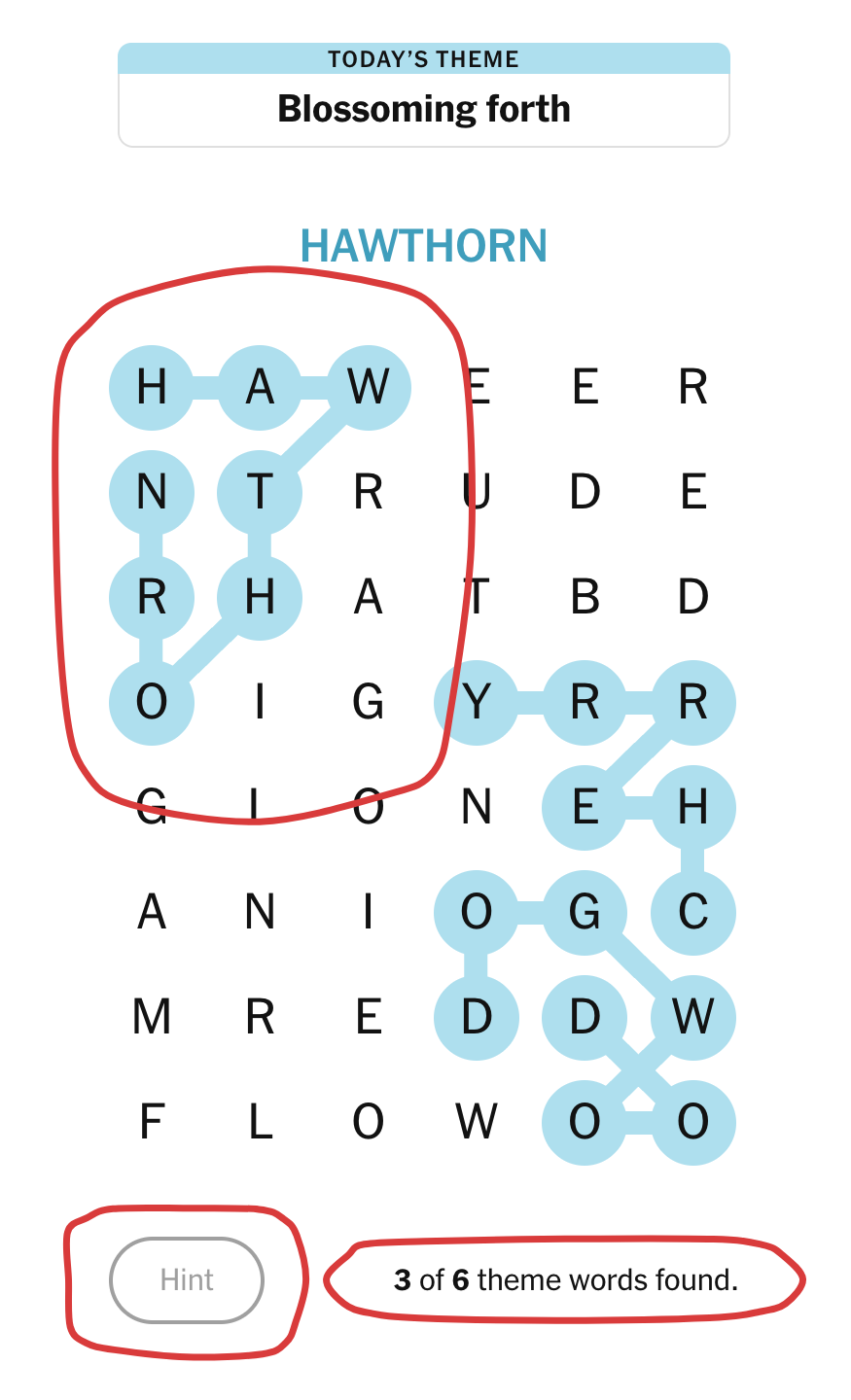
The counter tells you how many theme words remain, and it excludes the spangram, so a board reading “6 theme words” holds seven answers in total.
The hint meter sits next to the Hint button and fills in thirds. Until it is full the button is greyed out. This is the only mechanic in the game that rewards you for finding words that are not answers.
The highlight colours separate the two kinds of answer. Theme words take one colour as they lock in, the spangram takes another, which means the moment the spangram lands you can see its full path across the board.
What Every Strands Puzzle Shows About the Spangram
Here is where the archive earns its keep. All figures below come from all 885 published puzzles unless a smaller sample is stated.
It Always Touches Two Opposite Edges
885 out of 885. Not most, not almost all. There is no puzzle in the published history of the game where the spangram fails to connect one edge to the edge facing it.
That makes it the one structural guarantee you can lean on. Any candidate path that starts and stops in the middle of the board is not the spangram, and you can drop it without checking whether it spells anything.
It Runs Side to Side More Often Than Top to Bottom
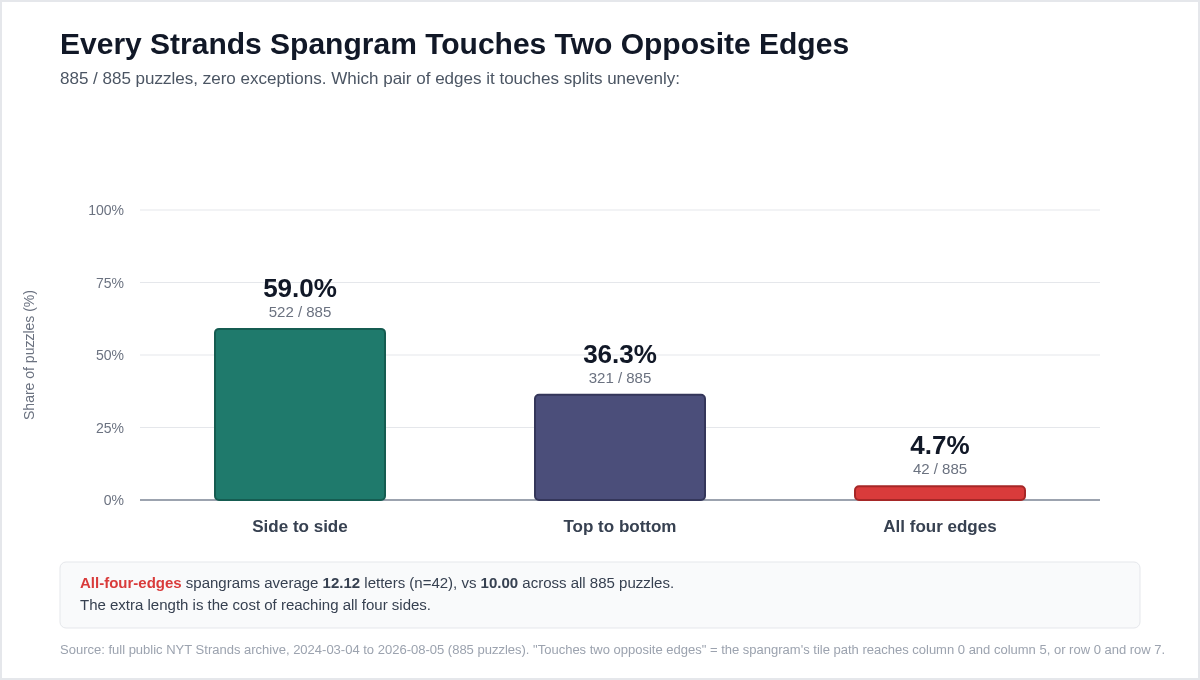
The rule says opposite edges. It does not say which pair, and the split is lopsided:
| Direction | Puzzles | Share |
|---|---|---|
| Left edge to right edge | 522 | 59.0% |
| Top edge to bottom edge | 321 | 36.3% |
| Touches all four edges | 42 | 4.7% |
The reason is geometry, and it has nothing to do with editorial taste. The board is six columns wide and eight rows tall, so a path crossing left to right has to span six columns, while a path crossing top to bottom has to span eight rows. The short axis is simply cheaper to build a word across.
The same logic explains the small four-edge category. Reaching every side at once takes a longer answer, and those 42 puzzles average 12.1 letters against 10.0 for the archive as a whole.
Practically: when you are hunting the spangram, sweep the left and right edges before the top and bottom ones. You will be right about six times out of ten.
Most Spangrams Are Not Real Words
FLOWERINGTREE is two words jammed together. That turns out to be the norm rather than the exception, and the puzzle data lets us count it, because each board ships with the list of dictionary words it happens to contain.
A caveat on the sample first. The way that list is built changed at the start of October 2024, and before that date it included the spangram automatically whether or not it was a real word. Measuring against it is only meaningful from October 2024 onward, which covers 674 puzzles.
In those 674 puzzles, the spangram is a genuine dictionary word 215 times, or 31.9%. The other 68% are compounds and phrases with the spaces removed.
This is worth internalising because it changes what you are looking for. Scan for a run of letters that would read as a phrase once you put the spaces back, and treat a single long dictionary word as the less likely case.
Spangram length itself ranges from 6 letters to 17 across the archive, so length alone will not identify it. The edge rule will.
Theme Words Come Back, Spangrams Almost Never Do
The two kinds of answer behave very differently across the archive.
Theme words repeat freely. Of 4,021 distinct theme words used across 885 puzzles, 965 have appeared on more than one date, which is 24.0% of them. Counting every repeat occurrence gives a similar picture at 1,375 of 5,396.
Spangrams almost never repeat. Of 868 distinct spangrams, only 15 have been used twice or more, and the joint record holders are HOMOPHONES and TITLES at three appearances each.
That asymmetry follows from what each one does. A theme word only has to be an example of something, and CHERRY can be an example of many things. A spangram has to name the whole theme, so reusing one means running essentially the same puzzle concept again.
The Board Is Stacked With Rare Letters
If Strands boards feel like they contain more awkward letters than ordinary English, that is because they do. Counting every cell of every board against standard English letter frequencies:
| Letter | Share of board cells | Standard English | Ratio |
|---|---|---|---|
| Z | 0.41% | 0.07% | 5.5x |
| K | 1.63% | 0.77% | 2.1x |
| Q | 0.19% | 0.10% | 2.0x |
| X | 0.25% | 0.15% | 1.7x |
| J | 0.25% | 0.15% | 1.7x |
| H | 3.10% | 6.09% | 0.5x |
| W | 1.41% | 2.36% | 0.6x |
Z appears more than five times as often as English would predict, and it is the largest outlier at every sample size we tested. H runs at about half its normal rate.
This makes rare letters useful anchors. A Z or a Q on the board is almost certainly load-bearing, because every cell belongs to an answer, and there are not many words that can absorb one.
There Is No Weekday Difficulty Ramp
The NYT Crossword gets harder from Monday to Saturday, and it is reasonable to assume the other daily puzzles work the same way. Strands does not.
We grouped all 885 puzzles by day of the week and compared theme word counts, spangram length, average answer length and board density. The clearest way to see the result is the medians: the typical Monday board and the typical Saturday board both hold 6 theme words, and the typical spangram is 10 letters long on all seven days.
The averages wobble a little, as averages do, but they wobble without direction. Nothing climbs from Monday to Saturday the way a crossword week does, and the differences are small in absolute terms, on the order of a tenth of a theme word or a quarter of a letter.
The more telling signal is what happens to those differences as the sample grows. Board density looked like a real weekday effect in our first 120-puzzle sample and steadily evaporated as we added data, from 0.68 down to 0.56 and then to 0.14 at full scale. Noise averaging out looks exactly like that. A real effect would have sharpened instead.
So a Saturday puzzle is not a harder puzzle. If today felt brutal, that is the individual board, not the calendar.
Strands Tips That Actually Help
Read the clue as wordplay. In a hand-checked sample of 30 clues, most were puns or idioms rather than plain category labels. “Blossoming forth” works as a nudge toward flowering trees, and reading it as a botany heading sends you looking for the wrong kind of word.
Chase the spangram first. It names the theme, so finding it converts every remaining answer from a blind search into a prompted one. It is also the longest answer on most boards, so it stands out once you know to trace the edges.
Sweep the side edges. Side to side accounts for 59% of spangrams against 36% running top to bottom, so start with the two long sides.
Use the rare letters as anchors. Z, K, Q, X and J are over-represented, and every one of them is part of some answer.
Spend off-theme words deliberately when stuck. They cost nothing, and three of them buy a full word. Being stuck is exactly the situation the hint meter exists for.
Remember that found words remove cells. Because the answers tile the board exactly, every word you lock in shrinks the search space for the rest.
Frequently Asked Questions
Is it spangram or spanagram?
Spangram, with no second A. The name comes from the fact that the answer spans the board, reaching one edge and the edge opposite it. “Spanagram” is a common misspelling and is not a word the game uses.
Can you use the same letter twice in Strands?
No. Each cell belongs to exactly one answer, and no answer reuses a cell within itself. Across all 885 archived puzzles the theme words and spangram together cover the 48 cells with no cell claimed twice and none left over.
How do the hints work in Strands?
The Hint button starts disabled and is powered by your mistakes, in the loose sense of words that are real but off-theme. Trace three such words and the meter fills, at which point spending a hint lights up all the letters of one theme word you have yet to find. It stops short of drawing the path, so you still have to work out the order.
Two consequences follow. Hints are unlimited in principle, since you can always find three more off-theme words on a dense board. And there is no penalty for hunting them, so on a board that has gone cold, deliberately fishing for filler is a legitimate strategy.
Is Strands harder than Wordle?
They are difficult in different ways. Wordle gives you feedback after every guess and caps you at six. Strands gives you no feedback at all until a whole answer is correct, and lets you guess forever. There is also no weekday difficulty pattern in Strands, so the variation you feel is board to board.
What is a spangram?
Think of it as the label on the box. The theme words are examples of something, and the spangram says what that something is: when the theme words are types of flowering tree, the spangram is FLOWERINGTREE. It takes its own highlight colour, it sits outside the theme word counter, and it always reaches from one side of the grid to the side opposite.
How many theme words are in a Strands puzzle?
Most often six, which covers 387 of the 885 archived puzzles. Five and seven are both common, and the full range runs from four to eight. The spangram is additional to that count.
Can you play past Strands puzzles?
Today’s board is open to everyone. Reaching older boards requires a paid NYT Games account. The underlying puzzle data stays publicly readable, which is how the counts in this article were produced, though we do not republish the puzzles themselves.
Where to Go Next
Readers who like the moment a theme clicks will find Connections the closest relative, rewarding a different kind of pattern spotting. We also keep a directory of other daily grouping and word-association puzzles at games like Connections, with a screenshot of each.
Prefer changing one word into another a single letter at a time? That is Poople, our own free daily word ladder.